Education · FORTUNE
Fortune #08
Good fortune
A new idea is easier to approach when you connect it to something familiar. Note both the similarity and the difference; the old idea is a bridge, not a perfect copy.
QUOTE CARD
A quote for you
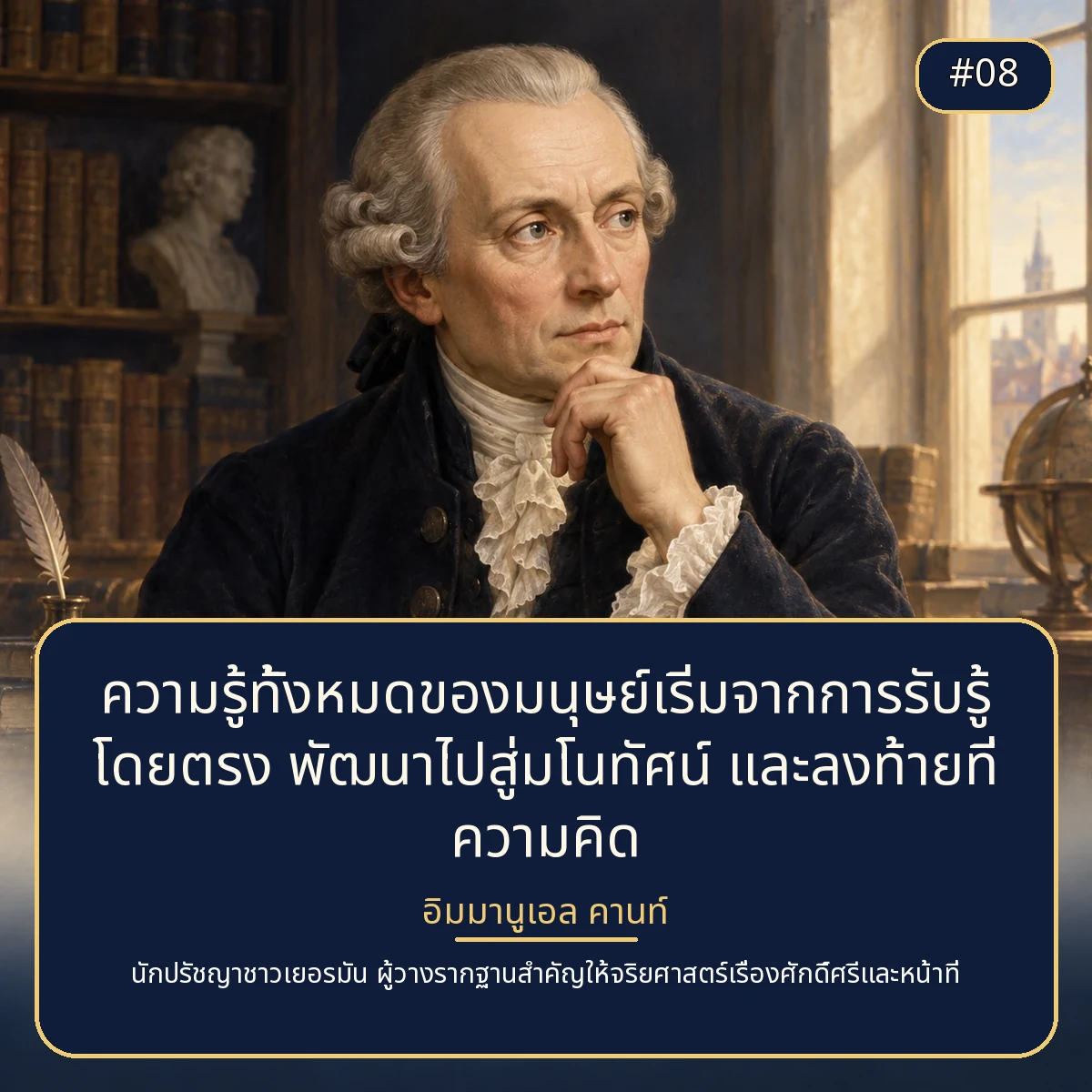
“ความรู้ทั้งหมดของมนุษย์เริ่มจากการรับรู้โดยตรง พัฒนาไปสู่มโนทัศน์ และลงท้ายที่ความคิด”
— อิมมานูเอล คานท์
นักปรัชญาชาวเยอรมัน ผู้วางรากฐานสำคัญให้จริยศาสตร์เรื่องศักดิ์ศรีและหน้าที่
- Person
- Immanuel Kant
- Source work
- B 730; Variant translation: All our knowledge begins with the senses, proceeds then to the understanding, and ends with reason. There is nothing higher than reason.
- Source text
- All human knowledge begins with intuitions, proceeds from thence to concepts, and ends with ideas.
STORY & REFLECTION
The Child Who Kept Asking
William Jones · a published anecdote
As a child, William Jones asked his mother what clouds were, why rain fell, and where the water went. She could not answer every question, so she encouraged him to look in books.
The published anecdote says he kept reading and became interested in many fields. Some later claims in the old account are hearsay; the exact numbers are not needed to value his curiosity.
A new question often begins with something already known. Jones saw clouds before asking about rain; one answer led to another question. Connections keep ideas from becoming isolated words on a page.
When you meet a new topic, write how it resembles an earlier one and how it differs. If you cannot connect them yet, you have found a useful question to pursue.
Reflection
Prior knowledge can be a bridge, not a limit.
A small action today
List two similarities and differences with what you already know.
A question to reflect on
How far does your earlier knowledge help explain this new idea?